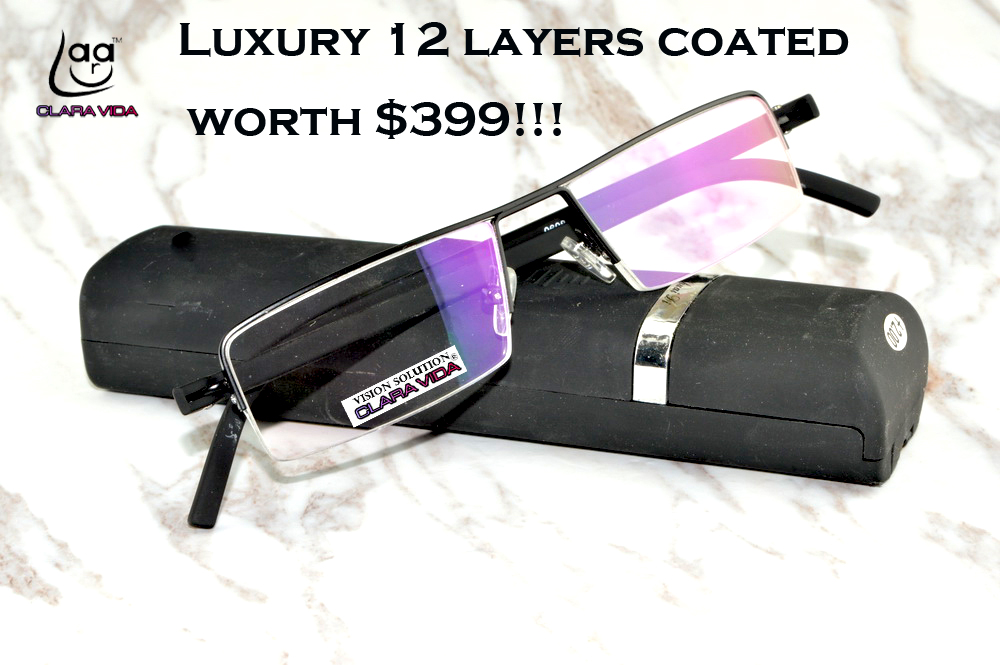
I understand the urgency. You need a pair of prescription reading glasses, and you need them now. Your eyes are exhausted from staring at a screen all day. You start browsing online and see countless pairs advertising "luxury quality" at an incredibly low price.
That's precisely what happened to me when I considered the =Clara Vida= options. I thought I had found a bargain on high-quality computer reading glasses. I was mistaken. I made these errors so you can avoid wasting your money, your time, or risking your eyesight. Learn from my experience.
I saw the ultra-low price tag on the =Clara Vida= readers and thought, "How bad could they be?" That was a major error. When glasses are suspiciously inexpensive, the compromise is always in the lens quality.
I ordered a +2.0 prescription reader, but the lens power was inconsistent. One side felt stronger than the other. This resulted in serious eye strain and a dull headache after just half an hour of computer work.
Simulated Low Review Insight: "The +2.5 strength I ordered felt weak and distorted my vision. I felt dizzy and got terrible headaches. I can only wear them for about 10 minutes at a time."
Cheap lenses often lack proper quality control. This means the optical center might be misaligned. If the lens center isn't positioned correctly in front of your pupil, your eye muscles strain to compensate for the distortion.
Verdict: Never compromise on lens quality. If a price seems too good to be true for claims like "12-layer coating," it likely is—and it could harm your eyes.
The product description boasted "top quality" and "luxury" frames. The moment I took them out of the box, they felt like cheap, brittle plastic. Within two weeks, one hinge began to loosen. A week later, the arm snapped off completely when I simply removed them from my head a bit too quickly.
This is a frequent problem with extremely cheap reading glasses. They use low-grade plastic that can't withstand daily wear and tear. You might save $10 now, but you'll likely need to buy a replacement pair almost immediately.
Simulated Low Review Insight: "I've had $5 readers that lasted longer than these. The plastic felt cheap and cracked near the bridge when I dropped them on the carpet. A complete waste of money."
Learn from my mistake. When buying any glasses, check if the actual frame material is specified. Look for durable, flexible materials like TR90 plastic or specific metal alloys. If the description only says "plastic frame," assume it's the cheapest option available.
Action Step: Inspect the hinge quality. If they appear to be tiny, fragile screws, they will likely fail quickly.